
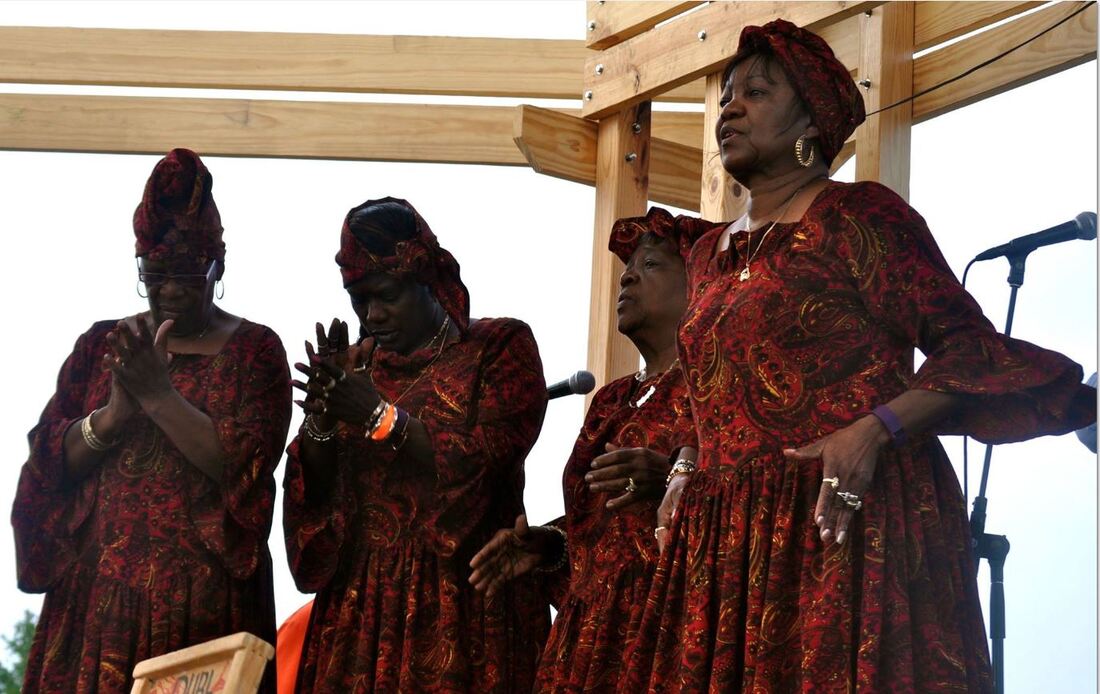
 McIntosh County Shouters. Darien, GA, 19 Jan. 2020. For the past week, the amazing co-founder of Inclusive Guide Parker and her family have been taking on their all-American cross-country road trip. As they hike, camp, and explore the great outdoors, in a way, they’re also time-traveling through U.S. history. Some stops are active timestamps, marking the distance between our past and present, as well as providing guidance and insight into a possible future. This week, our co-founder will be traveling back to Georgia and South Carolina to reconnect with their Gullah heritage.
The Gullah/Geechee people are descendants of enslaved Central and West Africans who were brought to the Sea Island plantations of the lower Atlantic coastline in the 1700s. Researchers designate the region from Sandy Island, SC, to Amelia Island, FL, as the Gullah Coast. However, the Gullah/Geechee are said to span as far north as the Virginia/North Carolina border. This unique culture has been linked to specific ethnic groups that are indigenous to West and Central Africa, bringing with them a rich heritage of cultural traditions. The geography and climate of the southeastern coast often brought disease to captors and enslavers, especially as they introduced new enslaved Africans to shore. Research states that “West Africans were far more able to cope with the climatic conditions found in the South.” As a result, some islands were completely left to the care and management of enslaved Gullah/Geechee people. This isolation brought a sense of relative autonomy to the enslaved people of the region, allowing them to retain much of their African heritage and, subsequently, develop a new, beautiful Gullah/Geechee culture. According to the New Georgia Encyclopedia, “Gullah” is the accepted name of the islanders in South Carolina, while “Geechee” refers to the islanders of Georgia. Anthropologists and historians speculate that both “Gullah” and “Geechee” are borrowed words from a number of ethnic groups such as the Gola, Kissi, Mende, Temne, Twi, and Vai peoples, all of which contributed to the subsequent “creolization” of the southeastern coastal culture in the U.S. The Gullah/Geechee also developed their own language, a form of creole mixed with the languages of West and Central African ethnic groups, as well as from their enslavers. According to the Gullah/Geechee Corridor, the Gullah/Geechee language is the only African creole language in the U.S. and has since deeply influenced Southern vernacular. The fact that hundreds of thousands of Gullah/Geechee remain in these marshlands and coastal islands doesn’t mean that they didn’t attempt to escape enslavement. Between the American Revolution and the Reconstruction Era, thousands of enslaved laborers from the Gullah/Geechee region gained their freedom by escaping to Nova Scotia. Self-emancipated Africans who were once harbored by the Spanish formed an alliance with Native American refugees in Florida,forming the Seminole Nation. Parker shares a story that her family told her about their great-great-grandmother and father (who was a baby at the time) who were being pursued by slave catchers. She talks about how the group was so afraid of being captured and taken back that they suggested killing the crying baby to avoid getting caught. Her family determined that if they killed the baby, the mother wouldn’t have survived. Instead, she sat under a bush, nursing the baby and trying to keep quiet until danger passed. There’s a huge possibility that our co-founder Parker might not be here had their elders gone through with this suggestion. This is not a statement of “pro-life,” however; this is a powerful testament to the terror of chattel slavery and the grave cost of the pursuit of freedom. Though originally brought as slaves to what is now part of the Gullah/Geechee region, Parker’s family has lived on James Island in South Carolina for hundreds of years. As she reconnects with her Gullah heritage, we keep in mind that many of the beliefs that substantiated the mass genocide of Indigenous peoples of the First Nations and the trans-Atlantic slave trade are the foundation of socioeconomic structures today. In order to truly change the world as we know it, we must take this knowledge with us and act. Stand up for Black and Indigenous rights in your own communities. Support legislation to tackle discrimination at the highest level. Donate to nonprofits and other groups trying to make a difference. One small way you can help is by supporting Inclusive Guide and the work we’re doing to address systemic racism and, more specifically, discrimination against Black and Indigenous communities. Using the Guide itself is a step in the right direction, but if you have the resources, we encourage you to contribute to our GoFundMe campaign so that we may continue the work of racial justice: https://www.gofundme.com/f/digital-green-book-website. |
KWEEN WERK NARRATIVESKWEEN stands for Keep Widening Environmental Engagement Narratives. Archives
January 2024
Categories
All
|
 RSS Feed
|
Contact Us |